Written By:
Tarun Jami
7 min
World’s First Verified Carbon-Negative Construction Block

Visakhapatnam-based GreenJams became the first Indian construction materials startup to publish a third-party verified Environmental Product Declaration (EPD) on the International EPD System, confirming that its Agrocrete® mix is carbon-negative from cradle to gate.
Tags:
Press & Media
A landmark for the construction industry
GreenJams has become the first Indian construction materials startup to publish an Environmental Product Declaration (EPD) for its flagship innovation, Agrocrete®. Through this transparent, third-party verified process, the company has shown that the Agrocrete® mix is carbon-negative from cradle to gate. You can download the full Agrocrete® EPD (PDF) or find it in the International EPD System library.
“This is a landmark for the global and Indian construction industry! For the first time the industry has access to a verified-carbon-negative building block. Through Agrocrete® we have now unlocked a new massively scalable and ultra low cost method for carbon capture while creating value for our all-important beneficiaries, the farmers. The possibilities are massive – with the 900 million cu.m. of potential annual Agrocrete® production we can capture at least 100 million tonnes of CO2 and prevent 350 million tonnes of CO2 emissions. This year ITC Ltd alone had captured 38.5 tonnes of CO2 and avoided 144 tonnes of CO2 emissions by using Agrocrete® at its project at Kapurthala” — Tarun Jami, Founder & CEO, GreenJams
The ITC project is documented in our Kapurthala perimeter wall case study: 28,000 Agrocrete® Solid Blocks, a 1.8 km wall and 38.5 tonnes of CO₂ stored in the blockwork.
What the EPD shows
The EPD shows that Agrocrete® is carbon-negative right from the start, because of the biogenic carbon stored in the crop residue it is made from. Its cradle-to-gate (A1–A3) global warming potential is −0.143 kgCO₂e per kg of moulded mix, usually rounded to −0.14. Put simply, each tonne of Agrocrete® stores about 140 kilograms of CO₂ more than its raw materials, transport and manufacturing emit.
The EPD also models the end of life. Demolition, transport, waste processing and landfill (modules C1–C4) add only about 0.01 kgCO₂e per kg, under a scenario in which 85% of demolished blocks are processed for recycling into aggregate or pavers. Adding those modules to A1–A3 still leaves a net figure of about −0.13 kgCO₂e per kg. Manufacturing at the plant (module A3) adds 0.042 kgCO₂e per kg, which is why the plant's energy supply matters.
What is an EPD, and why does it matter?
EPD stands for Environmental Product Declaration. The International EPD System describes it as a “verified and registered document that communicates transparent and comparable information” about a product's life-cycle environmental impact. It is a Type III environmental declaration under ISO 14025. In plain English, it is a standard, checkable way for designers and buyers to see what a product really emits, instead of taking a label on trust.
That matters because most sustainability claims are self-declared. Without an independent review, words like “low carbon” or “green” are hard to test. An EPD is built on a life-cycle assessment that follows agreed product category rules, and an independent verifier checks it before it is published. One caveat from the programme itself: an EPD does not, on its own, mean a product is better than the alternatives. It gives you the data to compare like with like.
“More often than not, products claim sustainability based on intuitions and intentions. As a carbon analyst for buildings, this means choosing building materials from companies throwing around words like “low carbon footprints”, “carbon neutrality”, and “green label”. There are endless ways of manipulating these claims. However, an Environmental Product Declaration (EPD) is the only ecolabel we trust without skepticism. It is exciting to see Agrocrete’s EPD prove GreenJams’s claims with a cradle-to-gate (A1-A3) GWP of -0.14 kgCO2e/kg. It confirms its status as a carbon-negative block and allows carbon storage even after the end of life.” — Mili Jain, Founder, Monk Spaces (the consultancy that prepared the EPD)
EPDs in India
In India, EPDs have mostly been published by large enterprises and multinationals, often as part of ESG reporting. Few of the products used in everyday Indian construction come with verified environmental data, which makes reliable comparison hard for architects and engineers designing for low carbon. With this EPD, GreenJams set out to give specifiers the transparency and data they need to build better buildings.
The Agrocrete® EPD at a glance
The table below summarises the key facts and climate results from the Agrocrete® EPD. All values are per kilogram of moulded Agrocrete® mix, the declared unit, and are taken directly from the published declaration.
Item | Agrocrete® EPD |
|---|---|
Product | Agrocrete® moulded mix (paddy straw, fly ash, ground slag and an alkali-activated slag binder), moulded into solid and hollow blocks |
Declared unit | 1 kg of moulded Agrocrete® mix |
Scope (modules declared) | A1–A3 (cradle to gate), C1–C4 (end of life) and D (beyond the life cycle). A4–A5 and B1–B7 not assessed |
GWP-total, A1–A3 | −0.143 kgCO₂e/kg |
GWP-biogenic, A1–A3 | −0.439 kgCO₂e/kg |
GWP-fossil, A1–A3 | 0.307 kgCO₂e/kg |
GWP-GHG, A1–A3 (excludes biogenic carbon) | 0.307 kgCO₂e/kg (given as 0.30 in the EPD's interpretation) |
GWP-total, C1–C4 combined | 0.0096 kgCO₂e/kg |
GWP-total, module D | −0.018 kgCO₂e/kg (avoided straw burning, reported separately) |
Standards | ISO 14025, EN 15804:2012+A2:2019, PCR 2019:14 Construction products |
Programme operator | EPD International AB (The International EPD® System, Indian Regional Hub) |
Verification | External independent verification by Sunil Kumar C S, Chakra4 Sustainability Consulting Services |
LCA prepared by | Mili Jain, Monk Spaces (One Click LCA, ecoinvent 3.6) |
Registration number | S-P-06876 |
Published / valid until | 21 October 2022 / 20 October 2027 |
Geographical scope | India (plant at Parawada, Visakhapatnam) |
How to read these numbers
The negative total comes from biogenic carbon. Paddy straw absorbs CO₂ as it grows, and that carbon stays locked inside the block. Straw is 9% of the mix by weight, while fly ash and ground slag, both industrial by-products, make up another 52%. Leave biogenic carbon out, as the GWP-GHG indicator does, and the mix emits about 0.30 kgCO₂e per kg. That is why any comparison should name its indicator.
Because the result is per kilogram, the EPD notes that it can be used to calculate the footprint of any block made from this mix if the block's weight is known. When you compare Agrocrete® with other walling, match the indicator, the modules and the declared unit. Download the Agrocrete® EPD (PDF, 17 pages).
How the Agrocrete® EPD was prepared
The EPD was prepared by Monk Spaces, a New Delhi-based carbon consultancy founded by Mili Jain, following the process set by the International EPD System. Primary data came from metered production at GreenJams' Visakhapatnam plant between November 2020 and August 2022, with background data from the ecoinvent 3.6 database. The process has five stages:
Choose the Product Category Rules (PCR). A PCR sets out how products in a category must be assessed and reported. The Agrocrete® EPD follows PCR 2019:14 for construction products.
Carry out a life-cycle assessment (LCA). The LCA, done to ISO 14040 and 14044, is the bedrock of the declaration. It can be done in-house or by a specialist consultant.
Transfer the LCA into the EPD format. Results are compiled into the standard reporting format required by ISO 14025 and EN 15804.
Independent verification. An approved verifier with knowledge of the product type, the industry and the relevant standards reviews the LCA and the EPD.
Registration and publication. The verified EPD is registered on the programme's portal with its supporting documents. It is then valid for five years.
Each stage leaves a record that someone other than the manufacturer has checked, which leaves very little room for manipulation. That is why, at GreenJams, we treat a verified EPD as the most trustworthy basis for any carbon claim we make.
This EPD was prepared and published with support from Terwilliger Center for Innovation in Shelter – Habitat for Humanity and Villgro Innovations Foundation, under the ShelterTech & Housing Accelerator Program, to make housing markets environmentally sustainable and inclusive in India.

Build with verified carbon-negative blocks
The EPD covers the mix used for both Agrocrete® Solid Blocks, our load-bearing format, and Agrocrete® Hollow Blocks, which are lighter and suited to insulated infill walls. Beyond the EPD, the GreenJams product catalogue lists the range as load-bearing at 7.5–13 MPa (CBRI-tested), with 4 hr+ fire resistance, zero efflorescence and a 10-year warranty against cracks, dampness and termites (manufacturer-declared). Browse the Agrocrete® catalogue for sizes and specifications, or get a sample to try on your next project.
For the bigger picture on why upfront emissions matter and how to reduce them, read our practical guide to embodied carbon in buildings.
About GreenJams
GreenJams is bringing high-quality, thermally insulating and carbon-negative building materials to the market, helping the construction industry lower its carbon footprint, save costs, and benefit socio-economically marginalized communities. Backed by almost half a decade of research and technological innovation, GreenJams is changing how building materials are manufactured and reversing climate change.
Today, they’re paving the way for the future built environment to become carbon-neutral and solving the acutely impacted public health through the prevention of crop residue burning. Recognizing their impact, GreenJams was listed on Forbes Asia’s ‘30 Under 30’. They are supported by the Ministry of Housing & Urban Affairs, Ministry of Science and Technology, Ministry of Agriculture and Farmers’ Welfare, and Agence Française de Développement.
GreenJams is also supported by TCIS-Habitat for Humanity, Villgro Innovations Foundation, Punjab Agri-Business Incubator and a-IDEA NAARM. The company is headquartered at Visakhapatnam, Andhra Pradesh, India. Learn more at www.greenjams.org, and follow on Facebook, Instagram and LinkedIn.
Related posts
•
3 min
Read more
Press & Media
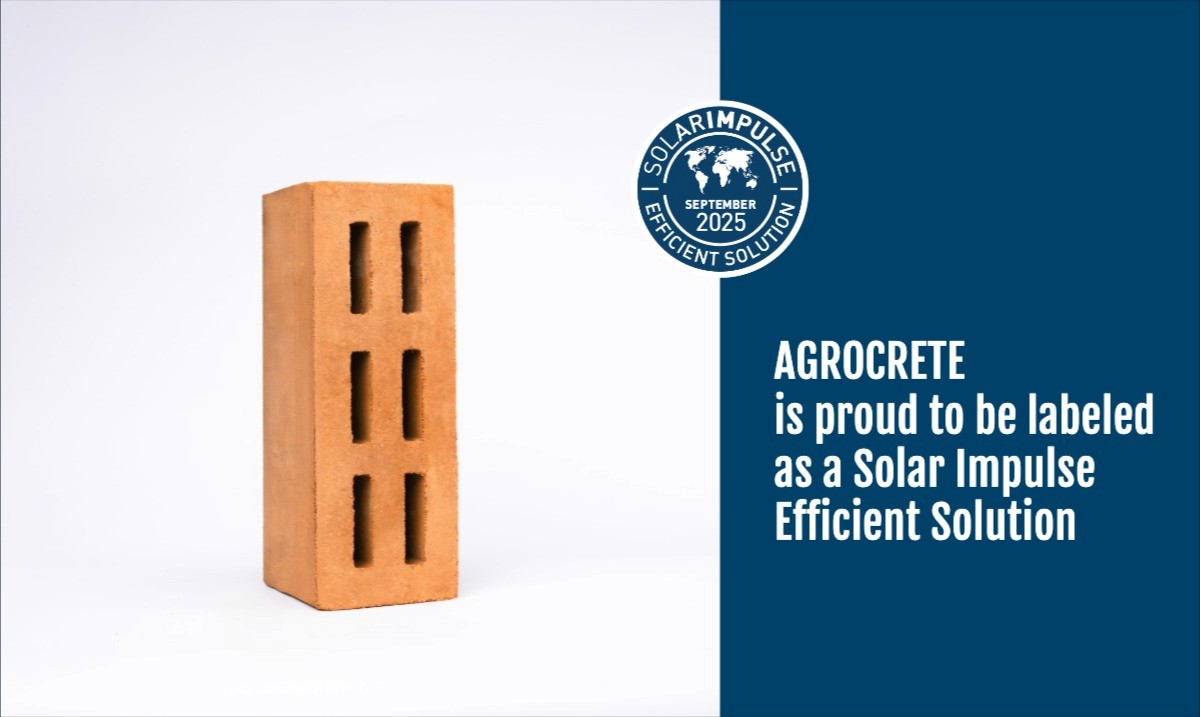
Agrocrete® Earns the Solar Impulse Efficient Solution Label
Agrocrete® earns the Solar Impulse Efficient Solution Label, making it India’s only carbon-negative building material with this global recognition.
•
3 min
Read more
Press & Media
GreenJams Named Winners of The Circulars Accelerator 2023
GreenJams, maker of Agrocrete®, is one of 16 global winners of The Circulars Accelerator 2023, an Accenture initiative with the World Economic Forum.

•
5 min
Read more
Press & Media
Vizag Start-up GreenJams wins Swachhata Startup Challenge 2022!
GreenJams wins the Swachhata Startup Challenge 2022 by MoHUA and AFD, receiving INR 25 lakh in funding plus mentoring and support to scale Agrocrete®.

 Agrocrete® spec sheet (PDF)